
|
A. Basic visual
neuroscience
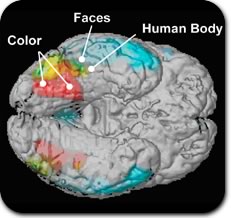
Colour is a fundamental aspect of our visual experience and enables us to recognize objects fast and reliably.
Traditionally, colour research has focused on colour as an isolated visual feature. However, it is now apparent that chromatic information also facilitates a multitude of other visual tasks and is available in many visual areas in the cortex (Werner et al., 2005; Werner, 2014; Werner 2017; Marschall & Werner, 2018).
Our aim is to try and understand the functional organization of cortical colour processes and their interactions with other submodalities (e.g. form, depth and motion) and tasks.
The results of our research are directly applicable in robotics e.g. for the development of artificial visual systems, as well as for medical advances in visual prostheses.
|
|
Colour Constancy
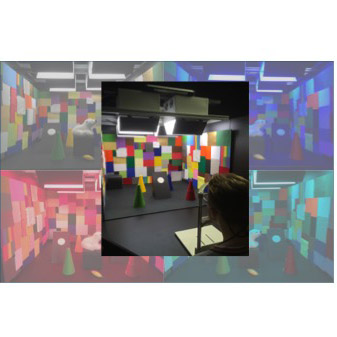
Most of the time, we perceive the colour of a ripe banana as being yellow - in spite of the fact that the spectral distribution of the light reflected from the banana into our eyes changes under different illuminations (compare the two images, one of which has more red illumination).
This phenomenon is called colour constancy. It is the product of a series of neural processes which comprise all stages of the visual pathways, and even includes cognitive influences. Colour constancy is therefore a central phenomenon in vision research, which may help to unravel the cortical computations underlying colour perception (Werner, A. 2006; 2007; 2014; Werner et al., 2000; 2003a; 2005).
|
|
Colour in Motion
Colour and motion perception are generally believed to be processed independently from one another, and for this reason classical colour research has primarily used static stimuli.
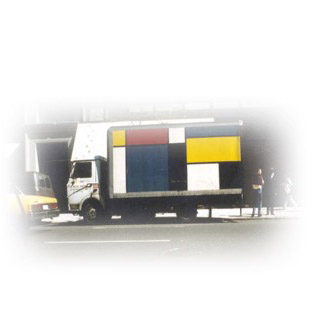
However, in real life many of the objects we see e.g. people, animals and cars also move. The aim of our investigations is to examine how colour and motion interact.
Our findings show that colour constancy is even improved if an object moves; the fact that this is specifc for object motion points at higher cortial areas as the origin, involving the third order motion system (Werner 2007).
|
|
Colour Illusions
#thedress
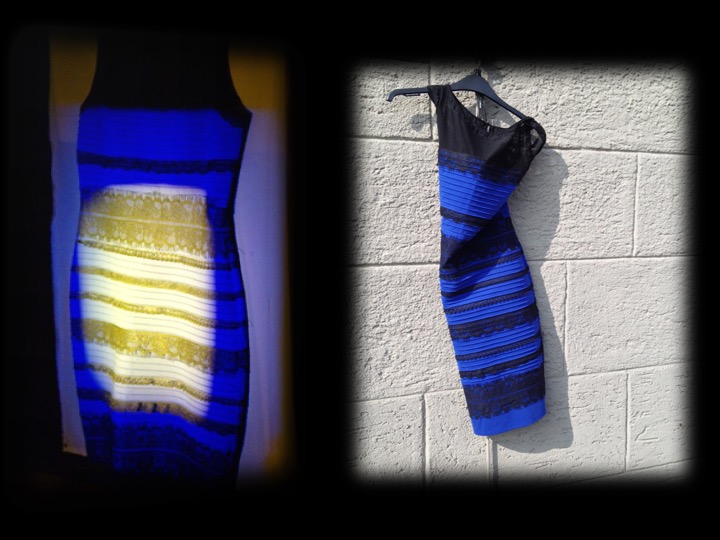
In 2015, the image of a dress attracted worldwide attention because it triggers completely different colour perceptions in viewers, i.e., either blue/black or white/gold. This is unusual in that no such ambivalence of colour-perception - as opposed to form or depth perception - had been known to date. Like other visual illusions, the dress-illusion is linked to the attempt of our brain to interpret correctly what is seen, in this case the light field in the scene. The dress-illusion demonstrates that these interpretations can indeed be very different between observers: Blue-Black viewers often report the dress to be in the bright sunlight, whereas White-Gold viewers interpret the dress as being in the shadow, with bright light coming from behind. What exactly causes these individual differences, however, is still an open question. A correlation between the percieved colour and the chronotype (and to some degree also to the age) of the observers has been established; in addition, individual differences in the perceptual organisation of the visual scene seem to be responsible for the different colour percepts. For a recent review of theories concerning the dress, and the most recent segmentation theory see (Werner et al., 2020).
In our lab we successfully reproduced and investigated the illusion with the real dress. In the video you can see the dress changing colour following manipulations of the spatial distribution of coloured illumination on the real dress (originally presented at VSS demo night 2015; A. Werner, M. Rudd; video by M. Olkkonen; see also Aston et al., 2020).
#theshoe
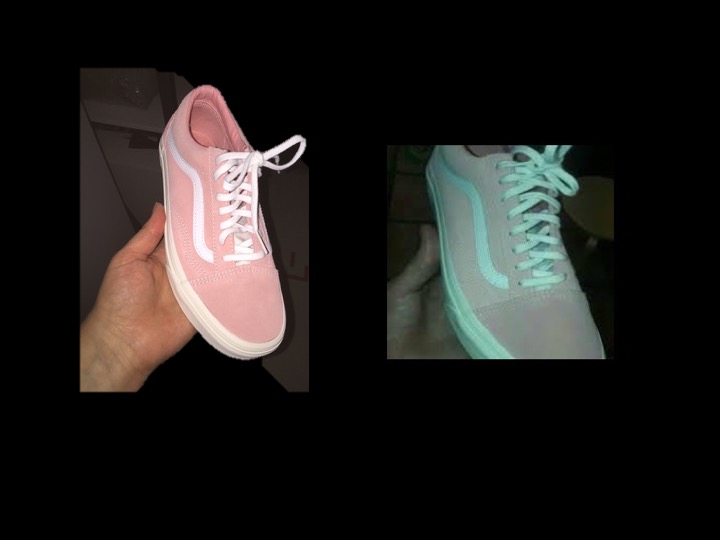
Which colours has the shoe? bluegreen & grey or pink & white? This is yet another colour ambiguity which needs an explanation. (Werner et al., 2018).
|

|
Colour in Action
The visual properties of objects, and the visual control
of a hand grasping them, are processed in separate pathways.
In this project we investigate how colour signals from
the perceptual pathway interact with signals from the motor
pathway when guiding hand movements. See also Dyslexia. |
|
Colour for Communication
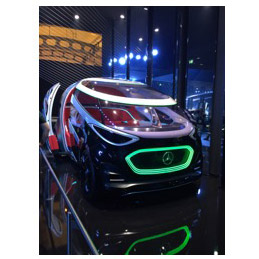
Colour is an important tool of communication, for animals as for humans. For example Yellow or Red are an uquibous sign for danger, understood universally across the species. In our everyday life, specific colour codes are used for traffic signs and must be easily recognizable and un-ambigous. Taking visibility, human colour preferences and legislative restrictions for traffic colours into consideration, we evaluated DAI Turquois as a suitable colour region for signalling autonomous driving vehicles (Werner 2018).
In addition to communication, colour has a high aesthetical value and catches our attention. Colour is therefore a popular feature in books for children, however it is important to understand that colour perception of very young children might differ from that of adults (Werner 2011).
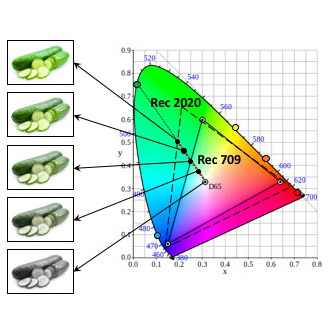
The range of colours that can be displayed on a colour monitor is limited to relatively unsaturated colours (Rec 709 standard). New technologies aim to widen this colour gammut to cover more saturated colours (the new Rec 2020 standard); in cooperation with researchers from Tokyo University and the Stuttgart Media University, we studied the effects of presenting images on wide-gammut displays (i.e. with highly saturated colours) on human observers (Kumakura et al., 2019).
|
|
B. Clinical Research
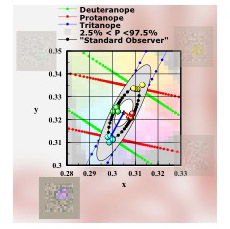
Since thh retina and its photoreceptors are a part of the brain, changes in colour vision are a sensitive indicator for neurodegenerative processes; as such, colour vision tests can be a usefull tool for early and differential diagnosis as well as for monitoring therapeutic effectiveness.
|

|
Achromatopsia und Gentherapy
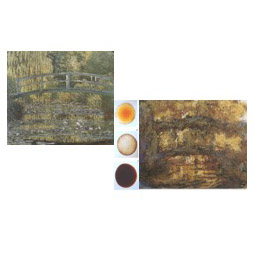
Achromatopsia is an inherited visual disorder, and is characterized by a complete or partial absence cone photoreceptor functions, which leads to severely impaired colour vision, amongst other visual dysfunctions. In the worldwide first clinical trail of gentherapy targeting human achromatopsia, we have used quantitative measurements of colour discrimination thresholds and colour constancy to determine the status of the cone function and the cortical processing of their signals following gentherapy. (Zobor et al., 2017; Michalakis et al., 2020)
|
|
Ageing
Ageing results in changes in the optical media (e.g.yellowing) as well as a partial neuronal loss, including receptors and connecting neurons. Nevertheless, some of these changes are compensated for by longterm adaptation and plasticity of the system. We have studied age related changes affecting chromatic and luminance contrast sensitivity, the blue/yellow opponent system (transient tritanopia) and colour constancy (Werner, 2006; Werner et al., 2010; Perez et al., 2013). |
|
C. Animal models
Colour Vision in Bees
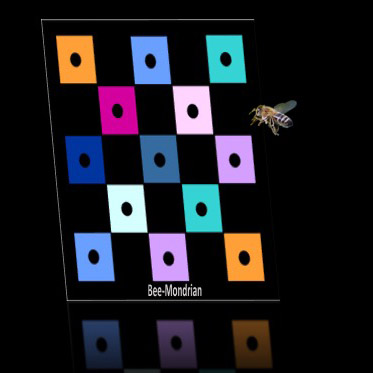
The honeybee (Apis mellifera) has excellent colour vision, ranging from UV through blue to green (but no red!). As in humans, the bee's colour vision is trichromatic and - albeit its brain comprises less than a million neurons - performs a high level of colour computations for object recognition and navigation. The bee is, therefore, an excellent animal model for understanding colour vision on an evolutionary basis and allows insights to how complex visual tasks can be sovled efficiently by small systems (Werner et al., 1988; Chittka et al., 2014; Werner, 2016). |
|
|


 •
•